July 21, 2026
July 15, 2026


On Monday, July 5th, Dr. Ioannis Christodoulakis, Fellow of the Center of Excellence in Sustainability, Assistant Professor in the Department of Natural Sciences, visited the Department of Optical and Rocket Soundings of IAP in Kühlungsborn, Germany.
The visit formed part of the broader initiative of the Center of Excellence in Sustainability (CoES) at The American College of Greece to advance research and raise awareness regarding the interconnected challenges of upper-atmosphere pollution, space debris, and overall space sustainability. As an initial step toward this strategic direction, CoES has set the goal of establishing an appropriate atmospheric monitoring station in Greece.
During the visit, Dr. Christodoulakis was briefed on the experimental lidar infrastructure developed at IAP for monitoring upper atmospheric layers—specifically between 80 and 100 km altitude. This system enables the detection of chemical species linked to human activities, such as lithium (Fig. 1). The lidar setup consists of a specialized laser unit (Fig. 1a), a dedicated telescope (Fig. 1b), and the required detection and electronic subsystems (Fig. 1c).
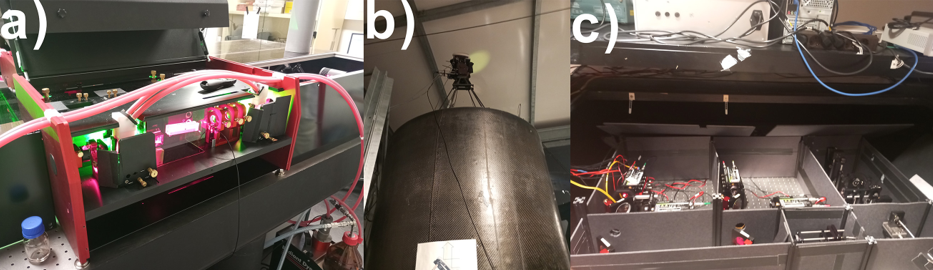
Figure 1 The lidar system developed at IAP for monitoring Li in the upper atmospheric layers. a) The laser component, b) the telescope, c) the detector component.
Dr. Christodoulakis also had the opportunity to present to the IAP research community the mission and activities of the Center of Excellence in Sustainability, the American College of Greece, and the ongoing research conducted within the School of Science and Technology. The visit aimed to establish a collaborative link between the two institutions, fostering the development of joint research initiatives in the future.
Within this framework, it was agreed to install in Athens the first noctilucent cloud (NLC) monitoring station in Greece. This station will become part of IAP’s international NLC camera network, contributing valuable observations of these rare and scientifically significant clouds formed in the upper mesosphere–lower thermosphere region.