EVENT

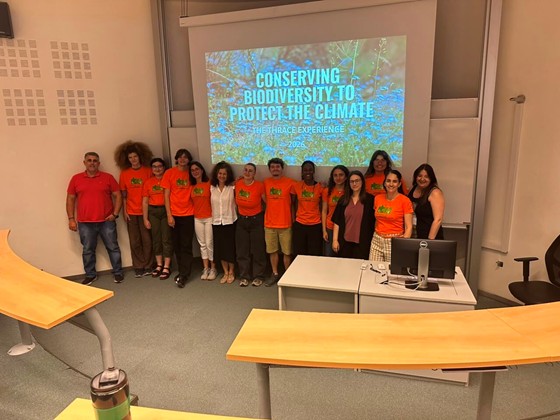
On the occasion of World Environment Day 2026, the Center of Excellence in Sustainability and the Environmental Studies Program of Deree, ACG organized a student-driven presentation on the importance of Conserving Biodiversity to protect the Climate as experienced during a Field Course in Thrace.
Efforts to assess and conserve biodiversity through fieldwork play a vital role in climate protection by safeguarding ecosystems that naturally regulate the Earth’s climate. Field research helps scientists monitor species, habitats, and ecosystem health, enabling the identification of environmental threats such as deforestation, habitat degradation, and species loss. Conserving biodiverse ecosystems supports carbon sequestration, as these ecosystems absorb and store significant amounts of carbon dioxide from the atmosphere. Healthy ecosystems are also more resilient to climate-related disturbances such as droughts, floods, and wildfires, helping communities adapt to climate change. In addition, biodiversity conservation preserves essential ecological functions, including soil fertility, water regulation, and pollination, which contribute to sustainable livelihoods and food security. Through evidence-based field work and conservation action, biodiversity protection strengthens nature-based climate solutions and supports long-term environmental sustainability for both people and the planet.
The presented experience was within the framework of the Field Course in Environmental Studies, a course that provides opportunities for active learning through field work and in-situ research on different thematic areas of interest to Environmental Studies, which in 2026 was implemented in Thrace, Greece, May 11 – 16. The field course was funded by the Helidoni Foundation, the School of Science and Technology, Deree – ACG, and the Center of Excellence in Sustainability, ACG.
The participating students presented the experiences gained on the field, the biodiversity and ecosystem issues, as well as practical, technical, management and social challenges.
The Agenda of the Event was as follows:
Opening
Dr. Stella Apostolaki, Supervisor of the Field Course in Environmental Studies, Executive Director of the Center of Excellence in Sustainability
Video – The field course experience
Prepared by Elena Lego, Student of the Environmental Studies Program
Nestos River – transboundary and management issues
Aris-Guy (Aria) Verney-Provatas, Student of the Environmental Studies Program
Nestos River Biodiversity
Philippe de Stoutz, Student of the Biomedical Sciences Program
The protected forest of Frakto – Overview and Management
Christina Christodoulou, Student of the Environmental Studies Program
The protected forest of Frakto – Biodiversity
Memory Kondowe, Student of the Environmental Studies Program
Nestos River Delta & Vistonida Lake – Overview and Biodiversity
Elena Lego, Student of the Environmental Studies Program
Dadia Forest – Overview & Management – Recovering from Fire
Zoi Trigkaki, Student of the Environmental Studies Program
Dadia Forest – Biodiversity
Ariadni-Anna (Rae) Lymperaki-Lara, Student of the Environmental Studies Program
Evros River Delta – Overview, Transboundary and Societal Issues
Nikita Vainores, Student of the Environmental Studies Program
Evros River Delta – Biodiversity
Konstantina Nikolaou, Student of the Environmental Studies Program
Closing – Q & A